
Remote Work Could Be Your Affordability Answer

For most first-time buyers, the hardest part of buying a home is making the numbers work. You budget, you save, and the finish line still feels far away.
But your salary is only half the equation. Where you live shapes what you can afford just as much. And if you can work remotely, you have an advantage a lot of buyers don't.
You're not tied to living where the jobs are, so you can look where your money goes further.
Where You Work Doesn’t Have To Dictate Where You Live
Remote job openings are on the rise. According to FlexJobs, remote job postings climbed 22% from the quarter before. That’s the second quarter in a row of double-digit growth.
More remote roles mean more people can choose a home base around the life they want to build. As Forbes puts it:
“Remote employees, freelancers, consultants, entrepreneurs, and business owners have the flexibility to choose a home base based on the life they want to build, whether that means more space, a lower cost of living, better access to nature, or simply somewhere new."
And you can use that freedom to look somewhere more affordable.
Your Paycheck Goes Much Further in Some States
Your cost of living – what you spend on housing, groceries, utilities, and the rest of daily life – varies a lot from one state to the next. In some, according to data from Extra Space, it runs far enough below the national average to change what you can afford (see map below):
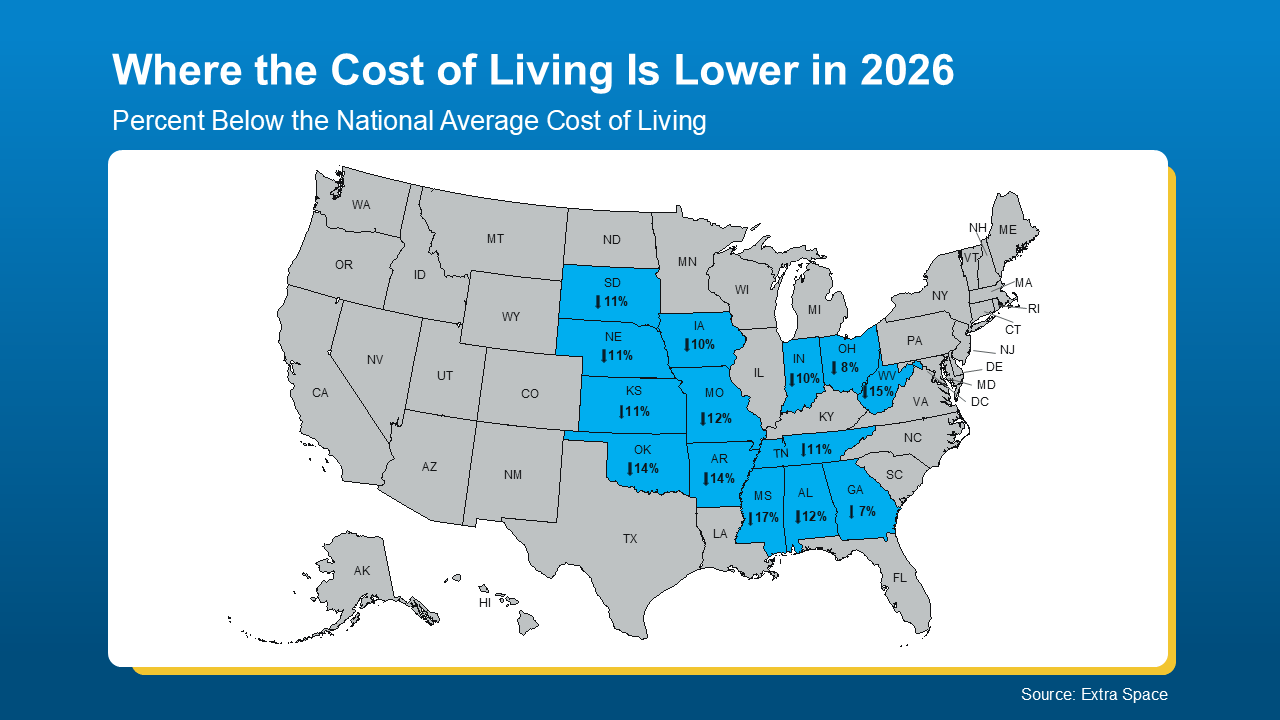 Take Mississippi, for example, where the cost of living sits about 17% below average, or West Virginia at roughly 15% below. When day-to-day life costs less, you can put more of your income toward your goals, homeownership included. Relocate Right describes it this way:
"Remote work has fundamentally changed the calculus of where to live. When your employer is in San Francisco, but you can work from anywhere, the question is no longer 'where are the jobs' but 'where does my salary go furthest and what kind of life can I build.'"
For a first-time buyer, working remotely could be a chance to put down roots and finally buy. Because with that kind of flexibility, you get to choose where to live and which places work best for your life and goals.
What To Weigh Before You Go
A lower cost of living is a great start. But it’s also important to consider the things a budget spreadsheet won't show you, because a place can look like a great fit on paper and still not feel like home.
-
Is the internet fast and steady enough to do your job without interruptions?
-
Will it be easy to make friends and settle into a routine once you arrive?
-
Does it have the amenities you want, like public transportation or decent takeout?
This is where a local real estate agent comes in. They can help you weigh a big move against a nearby one, because every state has more affordable pockets. Sometimes they’re closer than you think.
An agent will know which neighborhoods fit your budget and have the features you're after, whether that’s walkability, good restaurants, parks, or a nearby farmer’s market.
Bottom Line
With remote work, where you live can be your decision instead of your employer's. And that puts more affordable places within reach.
Want to explore where that could take you? Let's connect.
Categories
- All Blogs (191)
- Credit Scores & First-Time Home Buyers (1)
- Emotional Value of Homeownership (1)
- First-Time Buyer Guidance (1)
- First-Time Home Buyers & Affordability (1)
- First-Time Homebuyers (12)
- First-Time Homebuyers & Affordability (1)
- First-Time Homebuyers & Market Trends (1)
- Home Affordability & Relocation (1)
- Home Buying (5)
- Home Buying & Down Payment Strategy (1)
- Home Buying & Housing Market (1)
- Home Buying & Real Estate Strategy (1)
- Home Buying & Remote Work (1)
- Home Buying & Selling (1)
- Home Buying & Selling | Mortgage Rates | Real Estate Market (1)
- Home Buying & Selling Strategy (1)
- Home Buying & Selling Tips (1)
- Home Buying Preparation (1)
- Home Buying Strategy (1)
- Home Buying Tips (11)
- Home Buying Trends (1)
- Home Buying Trends & Strategies (1)
- Home Equity (2)
- Home Equity & Selling (1)
- Home Financing / First-Time Buyers (1)
- Home Prices & Buyer Opportunities (1)
- Home Prices & Housing Market (1)
- Home Prices & Market Trends (2)
- Home Prices & Real Estate Market (1)
- Home Seller Motivation (1)
- Home Selling (3)
- Home Selling & Fall Real Estate (1)
- Home Selling & Home Value (1)
- Home Selling & Housing Market (1)
- Home Selling & Housing Market Trends (1)
- Home Selling & Market Trends (1)
- Home Selling & Negotiation Strategies (1)
- Home Selling & Pricing Strategy (1)
- Home Selling & Real Estate Tips (1)
- Home Selling & Staging Tips (1)
- Home Selling Advice (4)
- Home Selling Strategy (1)
- Home Selling Tips (15)
- Home Selling Tips & Market Trends (3)
- Homebuyer Guides (1)
- Homebuyer Tips (2)
- Homebuying & Affordability Solutions (1)
- Homebuying Tips (1)
- Homeownership & Real Estate Investment (1)
- Homeownership Costs (1)
- Homeownership Tips (1)
- Housing Affordability & Mortgage Rates (1)
- Housing Inventory & Mortgage Rates (1)
- Housing Market & Foreclosure Trends (1)
- Housing Market & Home Buying (4)
- Housing Market & Home Selling (1)
- Housing Market & Home Values (1)
- Housing Market & Homeowner Equity (1)
- Housing Market Forecast (2)
- Housing Market Forecast & Real Estate Trends (1)
- Housing Market Insights (8)
- Housing Market Tips (1)
- Housing Market Trends (4)
- Housing Market Updates (23)
- Inflation, Mortgage Rates & Housing Market (1)
- Life Transitions & Homebuying Decisions (1)
- Luxury Real Estate (1)
- Market Trends & Forecasts (1)
- Market Trends & Insights (1)
- Market Update (1)
- Mortgage & Affordability (1)
- Mortgage & Finance (1)
- Mortgage & Financing (1)
- Mortgage & Home Buying (1)
- Mortgage & Interest Rates (1)
- Mortgage Rates & Federal Reserve (1)
- Mortgage Rates & Home Buying (1)
- Mortgage Rates & Home Buying Strategy (3)
- Move-Up Buyers (1)
- Moving & Selling Tips (1)
- New Construction (1)
- New Construction & Home Buying (1)
- New Construction & Homebuying (1)
- Real Estate / Housing Market (1)
- Real Estate Investing (1)
- Real Estate Market Insights & Homebuying (1)
- Real Estate Market Trends (1)
- Real Estate Market Update (5)
- Real Estate Trends (2)
- Retirement & Housing Decisions (1)
- Retirement & Real Estate (1)
- Seasonal Real Estate Trends (1)
- Seller Education & Market Insights (1)
- Selling a Home & Housing Market (1)
- Selling Tips (2)
- Senior Living & 55+ Communities (1)
- Senior Living & Downsizing (1)
- Strategy & Re-listing Tips (1)
- VA Loans & Veteran Homebuying (1)
Recent Posts











Associate Broker License ID: BR526609000
+1(602) 342-8006 | andrewm@themonaghangroup.com